Over the past several decades, hedge funds have emerged as one of the most influential and complex players in global financial markets. Once reserved exclusively for wealthy individuals and institutional investors, hedge funds are now widely discussed as innovative investment vehicles that push beyond traditional boundaries. They represent a new frontier in investing, defined by flexibility, advanced strategies, and an aggressive pursuit of returns.
Hedge funds are often misunderstood. Popular culture sometimes portrays them as secretive or excessively risky, while others view them as sophisticated tools for navigating volatile markets. The reality lies somewhere in between. Hedge funds are neither magical profit machines nor reckless gambles by default. They are structured investment partnerships designed to pursue returns using strategies unavailable to most traditional funds.
This article explores hedge funds as a new frontier in investing. It explains what hedge funds are, how they operate, why they were created, the strategies they use, the risks involved, and their evolving role in the modern financial landscape.
It is difficult to provide a general definition of a hedge fund. Initially, hedge funds would sell short the stock market, thus providing a “hedge” against any stock market declines. Today the term is applied more broadly to any type of private investment partnership. There are thousands of different hedge funds globally. Their primary objective is to make lots of money, and to make money by investing in all sorts of different investments and investments strategies. Most of these strategies are more aggressive than than the investments made by mutual funds.
A hedge fund is thus a private investment fund, which invests in a variety of different investments. The general partner chooses the different investments and also handles all of the trading activity and day-to-day operations of the fund. The investor or the limited partners invest most of the money and participate in the gains of the fund. The general manager usually charges a small management fee and a large incentive bonus if they earn a high rate of return.
While this may sound a lot like a mutual fund, there are major differences between mutual fund and hedge fund:
1. Mutual funds are operated by mutual fund or investment companies and are heavily regulated. Hedge funds, as private funds, have far fewer restrictions and regulations.
2. Mutual fund companies invest their client’s money, while hedge funds invest their client’s money and their own money in the underlying investments.
3. Hedge funds charge a performance bonus: usually 20 percent of all the gains above a certain hurdle rate, which is in line with equity market returns. Some hedge funds have been able to generate annual rates of return of 50 percent or more, even during difficult market environments.
4. Mutual funds have disclosure and other requirements that prohibit a fund from investing in derivative products, using leverage, short selling, taking too large a position in one investment, or investing in commodities. Hedge funds are free to invest however they wish.
5. Hedge funds are not permitted to solicit investments, which is likely why you hear very little about these funds. During the previous five years some of these funds have doubled, tripled, quadrupled in value or more. However, hedge funds do incur large risks and just as many funds have disappeared after losing big.
UNDERSTANDING WHAT HEDGE FUNDS ARE
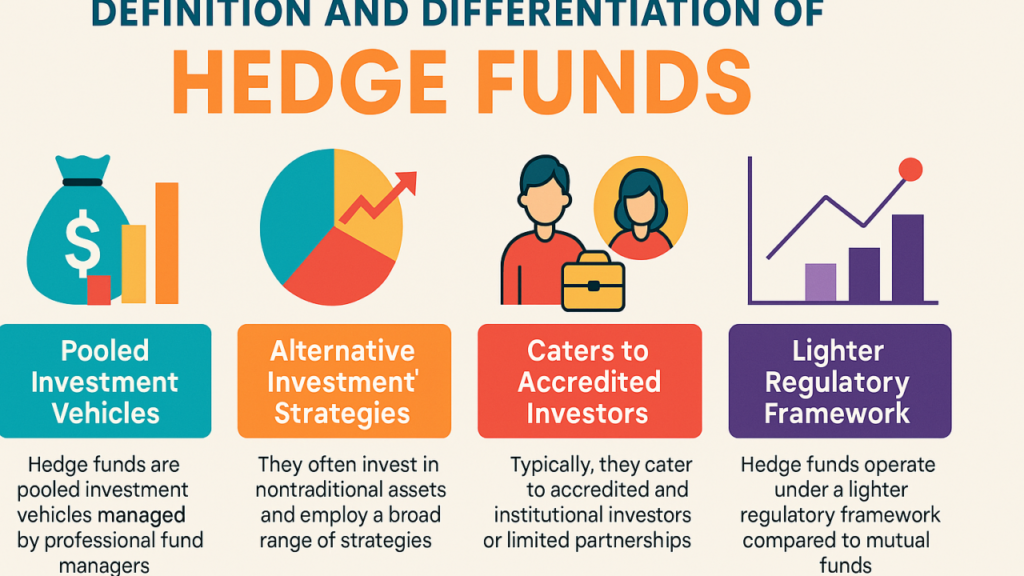
A hedge fund is a pooled investment vehicle that collects capital from accredited investors and institutions and invests it using a wide range of strategies. Unlike traditional mutual funds, hedge funds face fewer regulatory restrictions, allowing managers greater flexibility in how they invest.
Hedge funds may invest in stocks, bonds, derivatives, currencies, commodities, real estate, and private assets. They can take both long and short positions, use leverage, and employ complex trading strategies to generate returns regardless of market direction.
The term “hedge” originally referred to the practice of reducing risk by offsetting positions. While modern hedge funds may or may not actively hedge risk, the name has remained as the industry evolved.
THE ORIGINS OF HEDGE FUNDS
The first hedge fund is widely credited to Alfred Winslow Jones in 1949. Jones combined long stock positions with short selling and leverage to reduce market risk while seeking higher returns. His approach delivered impressive results and laid the foundation for the hedge fund industry.
Over time, hedge funds expanded in scope and strategy. By the late twentieth century, they had become prominent players in global markets, attracting capital from pension funds, endowments, and wealthy individuals seeking diversification and performance.
The growth of hedge funds marked a shift toward alternative investments, establishing a new frontier beyond traditional stocks and bonds.
WHY HEDGE FUNDS REPRESENT A NEW FRONTIER
Hedge funds differ from traditional investment vehicles in several key ways. Their defining characteristic is flexibility. Managers are free to pursue opportunities wherever they arise, unconstrained by benchmarks or rigid investment mandates.
This freedom allows hedge funds to innovate. They often adopt cutting-edge quantitative models, exploit market inefficiencies, and respond quickly to changing economic conditions.
Hedge funds also operate with a performance-driven mindset. Manager compensation is typically tied to returns, aligning incentives with investor outcomes. This structure encourages active management and creative problem-solving.
COMMON HEDGE FUND STRATEGIES
Hedge funds employ a wide range of strategies, each with unique risk and return profiles.
Long and short equity strategies involve buying undervalued stocks and shorting overvalued ones. This approach seeks to profit from both rising and falling markets.
Global macro strategies focus on large-scale economic trends such as interest rates, inflation, and geopolitical developments. Managers trade currencies, bonds, and commodities based on macroeconomic views.
Event-driven strategies capitalize on corporate events such as mergers, acquisitions, restructurings, and bankruptcies. These funds attempt to profit from price discrepancies created by uncertainty.
Relative value strategies exploit pricing inefficiencies between related securities. These strategies often rely on complex models and may use leverage to amplify small differences.
Quantitative hedge funds use algorithms, data analysis, and artificial intelligence to identify patterns and execute trades at high speed.
THE ROLE OF LEVERAGE IN HEDGE FUNDS
Leverage is a defining feature of many hedge funds. By borrowing capital, funds can increase exposure to investment opportunities and potentially amplify returns.
However, leverage also magnifies losses. Poorly managed leverage has contributed to some of the most famous hedge fund failures in history.
Successful hedge fund managers use leverage cautiously and strategically, balancing opportunity with risk control.
RISK MANAGEMENT IN HEDGE FUNDS
Risk management is central to hedge fund operations. Despite their reputation for risk-taking, many hedge funds devote substantial resources to managing downside exposure.
Common risk management techniques include diversification, position limits, stop-loss rules, stress testing, and scenario analysis. Sophisticated models assess how portfolios might perform under extreme market conditions.
Effective risk management separates sustainable hedge funds from those that fail during periods of market stress.
WHO INVESTS IN HEDGE FUNDS
Hedge funds are typically open only to accredited investors, such as high-net-worth individuals, pension funds, insurance companies, and university endowments.
These investors are assumed to have the financial capacity and sophistication to understand complex strategies and tolerate potential losses.
Minimum investment requirements are often high, reinforcing hedge funds’ exclusive reputation.
THE COST STRUCTURE OF HEDGE FUNDS
Hedge funds are known for their distinctive fee structure. The traditional model is “two and twenty,” meaning a management fee of two percent of assets and a performance fee of twenty percent of profits.
While fee structures have evolved due to competition, hedge fund fees remain higher than those of mutual funds or ETFs.
Supporters argue that higher fees are justified by superior returns and specialized expertise. Critics question whether hedge funds consistently deliver value after fees.
HEDGE FUNDS VS TRADITIONAL INVESTMENT FUNDS
Compared to mutual funds, hedge funds offer greater flexibility, broader strategy choices, and fewer regulatory constraints. Mutual funds, however, provide greater transparency, liquidity, and accessibility for retail investors.
Hedge funds may outperform in certain market conditions, particularly during periods of volatility. However, performance varies widely across funds and strategies.
Understanding these differences helps investors determine whether hedge funds align with their goals.
THE IMPACT OF HEDGE FUNDS ON GLOBAL MARKETS
Hedge funds play a significant role in modern financial markets. They provide liquidity, facilitate price discovery, and often act as early movers in emerging trends.
Critics argue that hedge funds can increase volatility or exploit market weaknesses. Supporters counter that they enhance market efficiency by correcting mispricings.
Regardless of perspective, hedge funds are now deeply embedded in the global financial system.
REGULATION AND TRANSPARENCY CHALLENGES
Hedge funds operate under lighter regulatory oversight than traditional funds. While this allows innovation, it also raises concerns about transparency and systemic risk.
Following major financial crises, regulators have increased reporting requirements and oversight for large hedge funds.
Balancing innovation with stability remains an ongoing challenge for policymakers.
THE EVOLUTION OF HEDGE FUNDS IN THE DIGITAL AGE
Technology is reshaping the hedge fund industry. Advances in data analytics, machine learning, and computing power have expanded the range of possible strategies.
Quantitative and algorithmic funds have grown rapidly, challenging traditional discretionary managers.
At the same time, increased competition has pressured hedge funds to innovate, reduce fees, and demonstrate consistent value.
COMMON MISCONCEPTIONS ABOUT HEDGE FUNDS
Many people believe hedge funds always outperform the market. In reality, performance varies widely, and many funds fail to beat benchmarks consistently.
Another misconception is that hedge funds are inherently reckless. While some take aggressive risks, others focus heavily on capital preservation.
Understanding these nuances leads to more informed discussions about hedge funds.
ARE HEDGE FUNDS RIGHT FOR EVERY INVESTOR
Hedge funds are not suitable for everyone. Their complexity, cost, and risk profile make them inappropriate for many retail investors.
However, for qualified investors seeking diversification, downside protection, or exposure to alternative strategies, hedge funds can play a valuable role.
The key is alignment between investor expectations, risk tolerance, and fund strategy.
FINAL THOUGHTS
Hedge funds represent a new frontier in investing, defined by flexibility, innovation, and strategic depth. They challenge traditional investment models and offer alternative pathways to generating returns.
While hedge funds are not without risk or controversy, they have become an enduring part of the financial ecosystem. Their ability to adapt, innovate, and respond to changing markets ensures their continued relevance.
For investors who understand their structure and risks, hedge funds can offer diversification and opportunity beyond conventional investments. As global markets evolve, hedge funds will continue to shape the future of modern finance.




Leave a Reply